


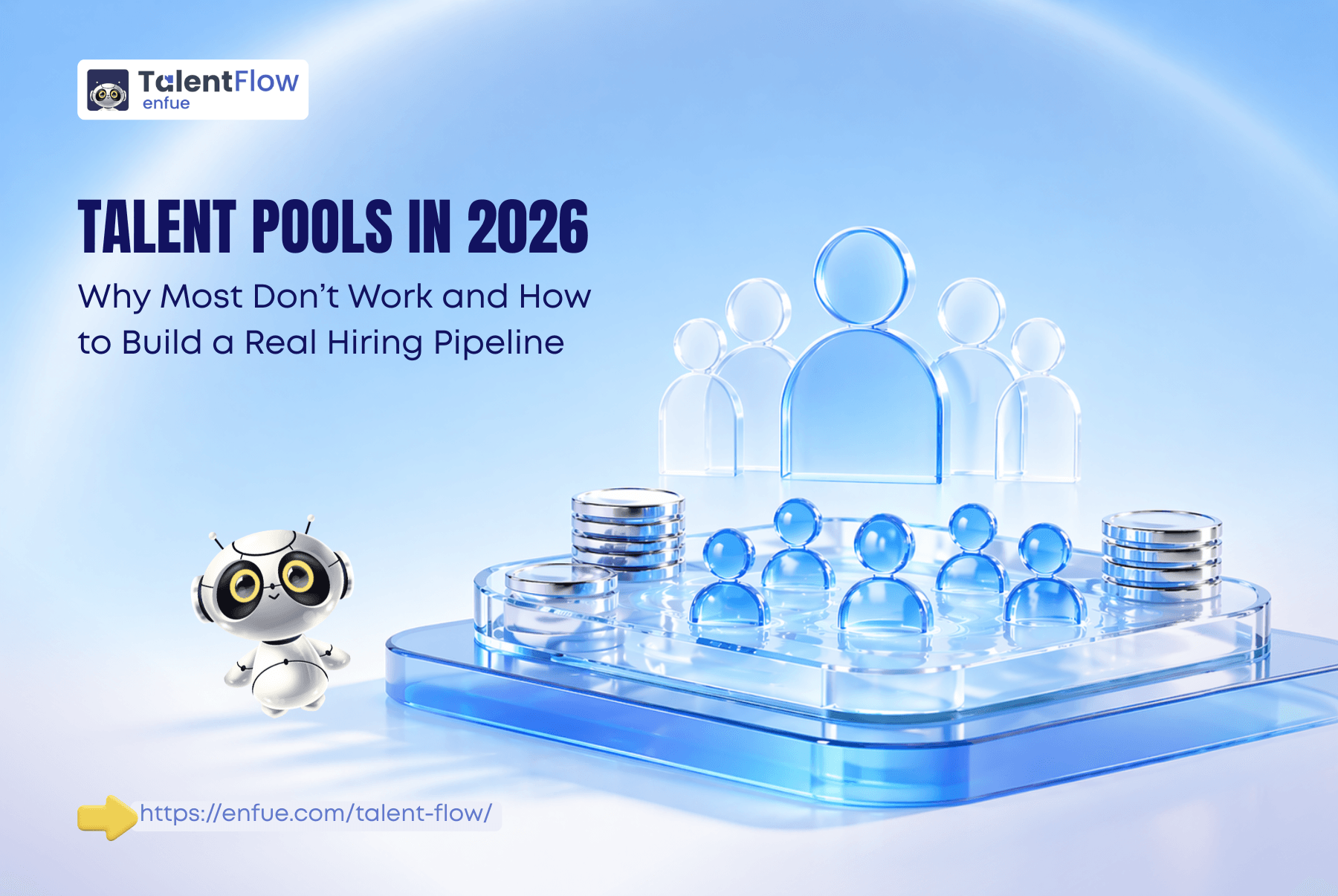
Talent Pools in 2026: Why Most Don’t Work and How to Build a Real Hiring Pipeline
- Posting more jobs
- Expanding sourcing channels
- Increasing spending on ads or agencies
What a talent pool actually is
Most companies already have a “talent pool”. But in reality, it’s often just a collection of resume just a collection of resumes. And stored data alone create no value. A modern talent pool should be understood differently:
“A structured pipeline of pre-qualified candidates that can be activated when hiring needs arise.”
The diffrence is not in how many candidates you have nut in whether you can actually use them:
- Can you find the right candidate within minutes?
- Do you have enough context to evaluate them quickly?
- Are they still engaged and open to opportunities?
If the answer is no, then it’s not a pipeline – it’s just data. A talent pool is not about collecting candidates. It’s about maintaining readiness.
Why most talent pools don't work
Many orfanizations invest time in building talent pools but fail to get real value from them. Why? Because they treat talent pool as storage, not systems. Common issues include:
- No clear structure or categorization
- No initial qualification process
- No ongoing engagement with candidates
- No way to quickly search or activate talent
The result is predictable: A talent pool that exists but is never actually used. And when hiring need arise, teams go back to square one.
Why talent pools are becoming a competitive advantage
A well-built talent pool doesn’t just improve hiring speed. It changes how hiring performs.
- Fastertime-to-hire
- No need to restart sourcing
- Immediate access to relevant candidates
- Better hiring decisions
- Candidates are evaluated before urgency kicks in
- Decisions are based on comparison, not pressure
- Lower hiring costs
- Less reliance on job boards and agencies
- Better use of internal data
- Greater control in a competitive market
- Engage talent before competitors do
- Build long-term relationships instead of one-time interactions
How to build a real hiring pipeline
A talent pool is not something you create once. It’s a system that needs to run continuously.
- Attract the right talent from the start
The quality of your pipeline depends on the quality of your input. To improve signal over noise:
- Write clear, transparent job descriptions (including salary and scope)
- Choose the right channels instead of mass posting
- Maintain consistent employer branding
The goal is not more applicants it’s better ones.
- Structure your data to make it usable
This is where most talent pools fail. Without structure, even large volumes of data become unusable. A functional talent pool requires:
- Initial screening or qualification
- Clear categorization based on:
- skills
- seniority
- role fit
- location
Without this, searching and activating candidates becomes inefficient.
- Maintainand activate your pipeline
A pipeline that is not maintained quickly loses value. To keep it effective:
- Stay in touch with candidates through updates and relevant opportunities
- Use automation to track and follow up consistently
- Regularly review and update candidate data
The goal is simple: keep candidates “warm” and accessible not outdated and forgotten.
Managing a talent pool: From storage to operation
Building a talent pool is only the first step. The real value comes from how you manage it.
Automate repetitive processes
- Follow-up emails
- Reminders
- Candidate tracking
Segment for efficiency
- Organize by role, skills, and seniority
- Enable faster and more accurate matching
Maintain data quality
- Remove outdated profiles
- Update candidate status regularly
Without proper management, even the best-built pool will degrade over time.
From reactive hiring to a scalable system
The difference between average hiring teams and high-performing ones is not access to talent. It’s whether they have a system in place before the need arises. Modern hiring doesn’t start when a role opens it starts long before that.
A better way to think about hiring
Hiring is no longer about filling roles one by one. Itu’s about building a system that continuously:
- Identifies talent
- Qualifies candidates
- Keeps them engaged
Companies that continue to hire reactively will always be one step behind. Those who invest in a structured talent pool will hire faster with clarity, consistency, and control.
Stop collecting candidates. Start building a system.
Most companies think they have a talent pool. In reality, they have a database they never use. Enfue helps you change that. Instead of starting from scratch every time, you build a hiring system that’s always ready:
- Structured data, not scattered resumes
- Active pipelines, not forgotten candidates
- Real-time visibility, not guesswork
This is the difference between hiring reactively and operating with control.
See how Enfue helps hiring teams build structured recruitment workflows, automate the repetitive work, and make better decisions with real data.
Talent Pools in 2026: Why Most Don’t Work and How to Build a Real Hiring Pipeline
Deliver more natural, intelligent, and human-like interactions with Conversational AI built on cutting-edge neural network architectures. Our system goes beyond basic chatbots—combining deep learning, language understanding, and adaptive reasoning to provide meaningful, context-aware responses.
Overview
Neural networks are the foundation of modern AI—powerful computational systems inspired by the interconnected neurons of the human brain. These advanced models are capable of learning from vast amounts of data, continuously improving their performance, and uncovering patterns that are often invisible to traditional analytical methods. With the ability to process massive datasets, interpret complex relationships, and make intelligent predictions, neural networks are transforming the way businesses operate in every industry.
From image recognition and natural language understanding to fraud detection and real-time decision-making, neural networks deliver unmatched accuracy and adaptability. Their layered architecture allows them to break down complex problems into smaller, learnable pieces—making them ideal for tasks such as identifying customer behavior trends, predicting operational outcomes, analyzing unstructured data, and automating processes that once required human expertise.
At OptimAI, we specialize in designing, training, and deploying custom neural models crafted specifically for your unique industry needs and business goals. Whether you’re looking to build a recommendation engine, enhance quality control with computer vision, or develop smarter forecasting tools, our team ensures your model is optimized for precision, speed, and scalability. We handle the full development cycle—from data preparation and architecture selection to training, fine-tuning, and seamless deployment into your existing systems.
By leveraging state-of-the-art deep learning techniques and industry best practices, we help your organization unlock deeper insights, automate complex workflows, and confidently adopt AI-driven strategies. Our neural network solutions are built to adapt over time, continuously learning from new data to keep your business ahead in a rapidly changing digital landscape.
What We Deliver
Custom Neural Architectures
We build deep learning models optimized for your data—whether it’s images, text, audio, or structured information. From simple feed-forward networks to advanced transformers, each model is designed for performance and scalability.
Data Processing & Model Training
Our end-to-end training pipeline includes data cleaning, feature engineering, augmentation, and hyperparameter tuning, ensuring your neural networks achieve peak accuracy and reliability.
Predictive Intelligence
Leverage neural networks to forecast trends, identify anomalies, and generate insights that support strategic decision-making across finance, healthcare, retail, logistics, and more.
Automation & Optimization
Use neural systems to streamline operations—automate manual tasks, improve workflows, and enhance customer experiences with adaptive, AI-driven intelligence.
Real-Time Decision Systems
Deploy neural models that process data in real time, enabling instant responses for fraud detection, recommendation engines, diagnostic tools, and high-frequency operations.
Multimodal AI
We build models that understand and connect multiple data types—like combining text, images, audio, and video—to create richer, more powerful AI experiences.
Key Benefits
- High accuracy in complex prediction and classification tasks
- Scalable systems built for long-term growth
- Automated workflows powered by intelligent decision-making
- Faster insights through advanced pattern recognition
- Flexible deployment across cloud, edge, or hybrid environments
Industries We Support
- High accuracy in complex prediction and classification tasks
- Scalable systems built for long-term growth
- Automated workflows powered by intelligent decision-making
- Faster insights through advanced pattern recognition
- Flexible deployment across cloud, edge, or hybrid environments

CTA
Discover the key features of our mobile app.
Discover the core features that power our mobile app—designed to simplify your workflow, boost productivity, and deliver a seamless user experience.