



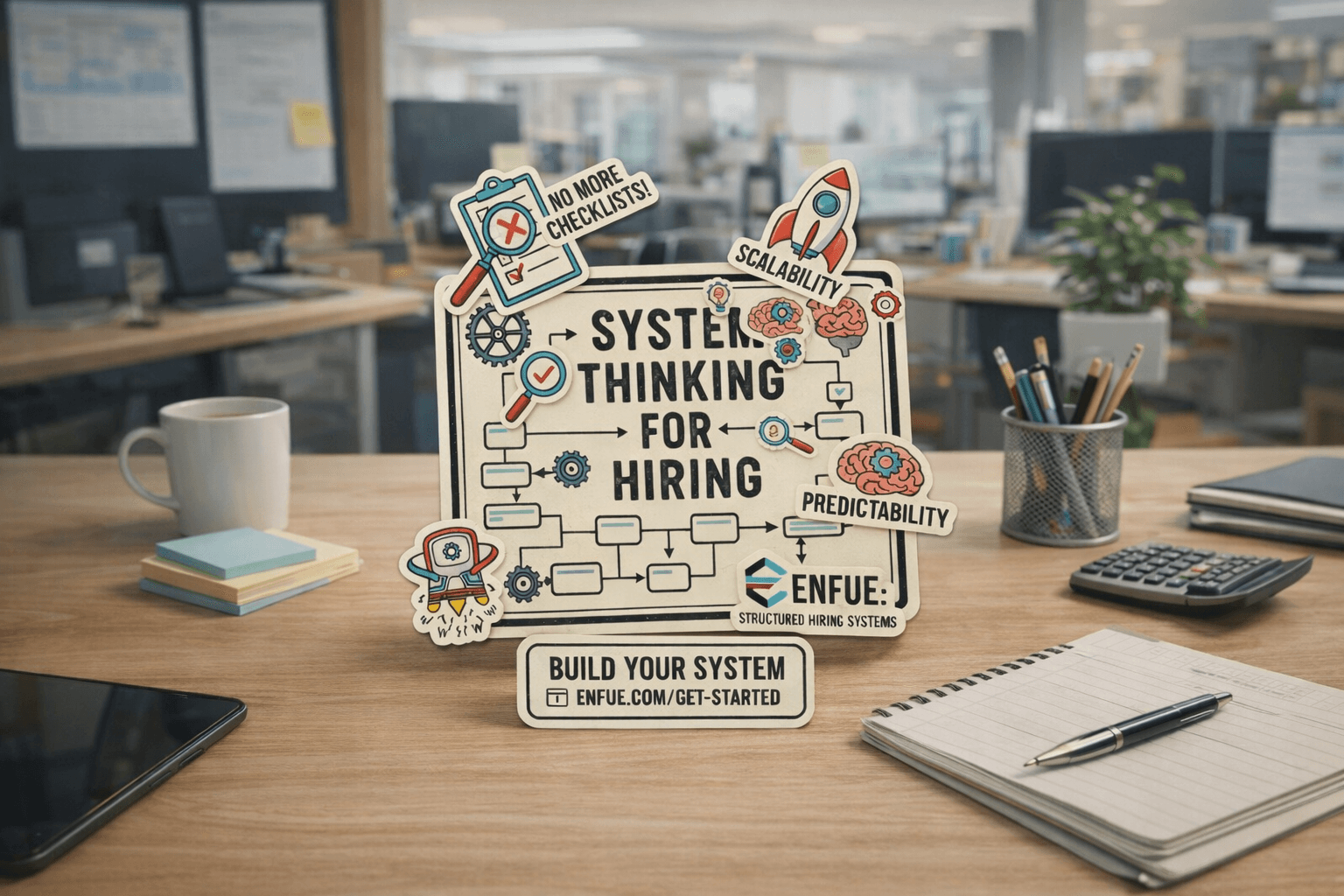
Most leaders approach hiring like a grocery list: post a job, screen a resume, conduct an interview, buy the talent. It’s a linear checklist. But when you treat hiring as a series of isolated tasks, you’re left wondering why the “perfect” candidate quit after three months or why it takes forever to fill a role.
At enfue, we believe the secret to predictable growth isn’t a better checklist – it’s a better system.
🔍 The Anatomy of a Hiring System
To build a scalable company, you have to stop looking at hiring as an event and start looking at it as a machine. In systems thinking, every output is the result of how various components interact. Here is how that translates to your talent pipeline:
Inputs
This isn’t just a job description. Inputs include your employer brand, the quality of your sourcing channels, and the specific data points you require from applicants. If you put “garbage” data in, you get a “garbage” hire out.
Processes
These are the mechanics – your structured interview rubrics, automated assessments, and communication workflows. A true system ensures that Candidate A and Candidate B are measured against the same yardstick, removing the “gut feeling” bias that plagues most startups.
Feedback Loops
This is where the magic happens. A system asks: “Did the person we hired six months ago actually meet our performance goals?” If the answer is no, the feedback loop triggers a change in the Inputs or Processes.
Outcomes
The goal isn’t just a “signed offer.” The outcome of a healthy hiring system is retention, cultural alignment, and time-to-productivity.
⚙️ Why Systems Thinking Wins
When you shift from a checklist to a system, you gain:
Predictability
Scalability
A checklist depends on the individual recruiter. A system is repeatable. It allows you to forecast how many candidates are needed to produce one strong hire and lets you scale hiring up or down with confidence.

🧠 The enfue Philosophy
At enfue, we don’t just help you fill roles – we help you build hiring infrastructure. With a structured, repeatable hiring system, founders and HR leaders can focus on business growth instead of manual coordination and scattered data.
Hiring works best when it runs as a system – not a checklist.