



How to Answer “Why Do You Want to Work Here?” Even When You’re Not Sure Yet
A simple question that reveals more than most candidates expect
“Why do you want to work here?” sounds simple, but it’s often where candidates struggle the most. Not because they have nothing to say, but because they haven’t fully thought through why this particular role or company makes sense for them.
For hiring managers, the question is less about hearing a perfect reason and more about understanding a candidate’s intent, self-awareness, and fit with the role.
You Don’t Need a Perfect Reason. You Need a Thoughtful One.
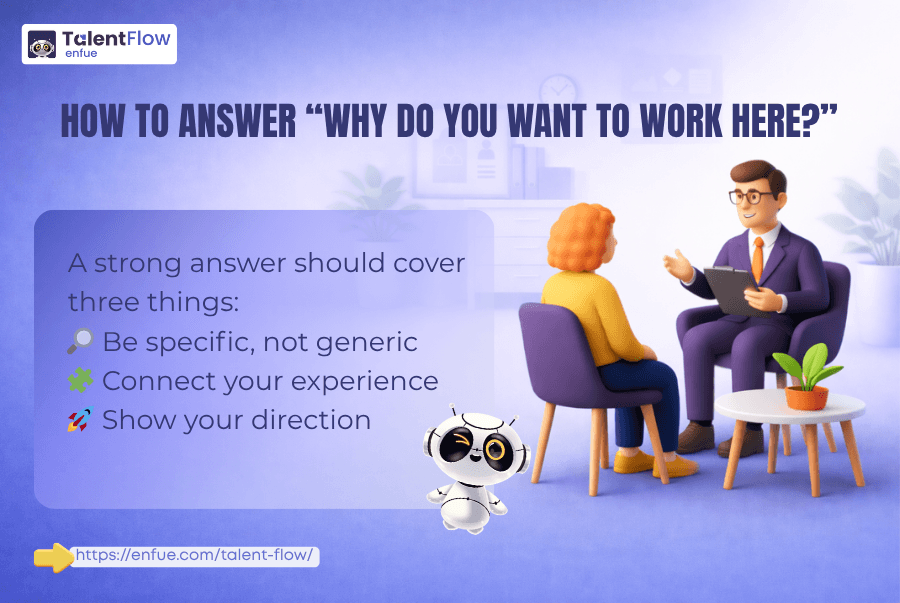
Many candidates apply while still figuring out what they want, and that’s normal. What matters is showing that the decision is intentional. Instead of saying “I just think this is a good company,” a stronger answer connects something specific about the company to what the candidate is looking for: “I’ve been following how your company is expanding in the fintech space, and I’m interested in roles where I can work closer to product and data.” This shows why the opportunity interests them, rather than giving a generic answer.
The same applies to the role. Instead of “This role seems very exciting to me,” candidates can explain how their experience connects to the work, making their interest more concrete and relevant.
Show Direction, Not Just Motivation
Another common answer is “I want to learn and grow.” While genuine, it is too broad to tell a hiring team much. A stronger answer shows what the candidate wants to develop and why this role fits that direction: “I’m looking to develop stronger skills in B2B sales, particularly in longer sales cycles, and this role seems like a good opportunity to build that experience.” Candidates don’t need a perfect career plan, but they should be able to connect what they know about the company, what interests them about the role, and what they can bring or want to develop.

What Hiring Teams Are Really Evaluating
Behind “Why do you want to work here?”, hiring managers are often looking at whether the candidate applied intentionally, understands their own strengths and interests, and sees a realistic fit with the role.
A thoughtful answer can provide useful signals, but different interviewers may interpret the same response differently based on their own expectations and experiences. This can become especially challenging in high-volume hiring, where small differences in judgment can make decisions less consistent.
From Individual Judgment to Structured Evaluation
Behind “Why do you want to work here?”, hiring managers want to understand whether the candidate applied intentionally, knows their strengths, and sees a realistic fit with the role. However, even thoughtful answers can be interpreted differently by different interviewers. One may see an answer as thoughtful and realistic, while another may see it as lacking enthusiasm. This becomes more challenging when teams evaluate large numbers of candidates across multiple roles, where individual judgment can lead to inconsistent decisions.
To address this, more hiring teams are moving toward structured evaluation. Instead of relying entirely on personal interpretation, teams can define clear criteria and align interviewers on what they are looking for.
Want to make candidate evaluation more structured?
- See how your team can standardize evaluations, gain visibility into your hiring pipeline, and make faster, more confident hiring decisions