



A poor candidate experience rarely starts with the candidate. More often, it begins inside the company – with unclear hiring steps, scattered decision-making, and inconsistent communication among the hiring team. What candidates see on the surface – delays, mixed messages, or silence, is usually a reflection of internal hiring confusion.
Many organizations assume candidate experience is mainly about employer branding or recruiter friendliness. In reality, it is a process outcome. When the hiring workflow is unclear internally, the candidate journey becomes unpredictable externally.
🔍 Unclear steps create visible friction
When recruiters and hiring managers are not aligned on stages, evaluation criteria, or decision authority, the process becomes improvised. One interviewer asks competency questions, another focuses on culture fit, and a third repeats the same screening topics. Candidates feel the repetition and inconsistency. It signals that the company is not fully prepared – which quietly weakens trust.
⏳ Delays are usually decision bottlenecks, not scheduling issues
Candidates often experience long waiting periods between stages. Internally, this is often caused by missing feedback loops, unclear approval paths, or dependence on a single busy stakeholder. Without defined turnaround-time targets and stage owners, decisions stall.
From the candidate’s perspective: ❗ silence feels like rejection or disrespect.
From the company’s perspective: 🗂️ it is “still under review.”
That perception gap damages employer reputation.

💬 Inconsistent communication reveals process gaps
If candidates receive different messages from different interviewers or no updates at all – it usually means communication is not systemized. Recruiters may track status in spreadsheets, inboxes, or personal notes. Hiring managers may not know when updates were sent. Without a shared source of truth, communication becomes fragmented. Candidates experience confusion; internally, it’s simply lack of visibility.
⚙️ Structured processes improve both sides
A structured hiring process upgrades both internal efficiency and external perception:
✅ Clearly defined stages
✅ Standard evaluation criteria
✅ Assigned decision owners
✅ Shared pipeline visibility
✅ Timely, triggered communications
When structure exists, teams move faster with less friction. Feedback becomes comparable. Decisions become evidence-based. Communication becomes predictable. Candidates receive consistent updates because the system supports the workflow – not because someone remembers manually.
Structure does not make hiring rigid. It makes it repeatable and fair. It reduces cognitive load so recruiters and hiring managers can focus on candidate quality instead of process coordination.
🧭 Where enfue ATS fits
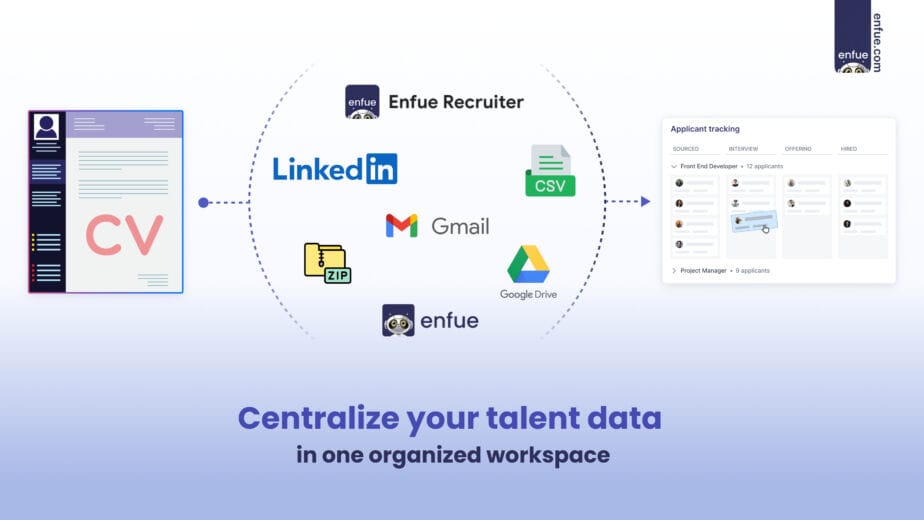
Enfue centers hiring around clarity and consistency – turning recruitment into a structured, trackable workflow with visible pipelines, standardized stages, and unified candidate data. When everyone works from the same system, confusion drops and candidate experience improves naturally.
Candidate experience is not an extra layer added on top of hiring. It is the mirror of your internal process. When your hiring system is clear and consistent inside, the candidate journey becomes stronger outside.

 News: enfue strives to become the #1 Applicant Tracking System in Vietnam: Explained video →
2 Comments
Comments are closed.