



What Is Job Shadowing? And Why It Reveals More About Your Hiring Than You Think
Most hiring failures happen before day one
You hired someone strong. Their resume was solid, the interview went well, the hiring manager was excited. Three months later, they’re gone and no one can quite explain why.
The real reason is rarely incompetence. It’s misalignment between what the role was described to be and what it actually demands day to day.
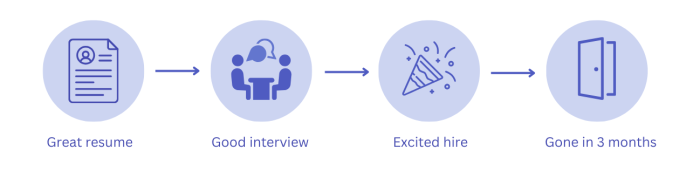
That gap doesn’t show up in technical assessments. It doesn’t surface in culture-fit rounds. It only becomes visible when someone is already sitting in the seat and by then, the cost of getting it wrong has already landed.
What job shadowing actually is
Job shadowing is when a candidate typically at the final stages of your hiring process spends time observing the person currently in or closest to the role they’re applying for. No extra interview. No theory test. Just unfiltered, real-world visibility into what the job actually looks like.
"Job shadowing is a mutual expectation calibration and the discomfort it surfaces is exactly the point."
it is
- Real – world visibility
- Expectation calibration
- A two-way evaluation
- A source of truth
it isn't
Why hiring breaks down without real job visibility
Research consistently shows that misaligned role expectations are among the top reasons new hires leave within the first six months. Not compensation. Not culture. Unmet expectations.
Misaligned expectations are a top reason new hires leave within the first 6 months
Up to
30%
A real pattern that plays out across scaling companies:
A startup hires a senior Content Strategist based on a brief promising “full ownership of content direction.” In reality, 70% of the week is social captions and design brief reviews.
The hire exits at month 3
The cost of backfilling:
70%
1.5x
How job shadowing improves hiring when done right
When done well, job shadowing creates clarity for candidates, confidence for your team, and better outcmes for your business.
- Stronger candidate experience

Candidates who see the reality before accepting an offer trust the company more.
Showing the unglamorous parts of a role builds confidence not doubt.
Hires who shadow tend to onboard faster and stay longer.
- Higher hiring accuracy

When candidates see the real job, those who aren’t a true fit often self-select out.
That’s not a loss it’s the process working exactly as intended.
A withdrawal before signing is far less costly than a resignation after onboarding.
- Sharper internal alignment

Preparing a shadow session forces hiring managers to answer:
“What does this role actually involve?”
It’s a question many teams have never sat down to answer rigorously.
The clarity it creates benefits every hire that follows.
The real limitations you need to hear
It doesn’t scale
You cannot put 40 candidates a month through a shadow program. It consumes the time of the person being shadowed, disrupts workflow, and demands coordination that compounds quickly under hiring volume.
It only works late in the funnel
Job shadowing is only meaningful when you’ve already filtered to your top two or three candidates. If the earlier stages of your hiring process are chaotic, shadowing can’t compensate for what was already missed.
Without structure, it produces no insight
A shadow session without a debrief framework, a standardized feedback form, or a clear set of observations to capture is just a workplace tour. It generates goodwill but no hiring intelligence.
It cannot fix a broken hiring process
A strong shadow experience doesn’t compensate for a recruitment workflow that has no central pipeline, inconsistent evaluation criteria, or zero visibility into where candidates stand. The foundation has to be there first.
When job shadowing isn't enough: what modern hiring actually needs
Job shadowing is a good signal. But the underlying problem it’s responding to is usually structural: a hiring process that runs on scattered emails, Slack threads full of informal feedback, no single record of where each candidate stands, and no data to learn from.
That’s not a job shadowing problem. That’s a recruitment workflow problem.
And it’s exactly what a well-configured applicant tracking system is built to solve.
Centralized pipeline and candidate data
Consistent evaluation and feedback
Automatics tasks and follow-ups
Real-time visibility and reporting
Data-driven decisions
Job shadowing is a sympton, not a cure. It can show you the gaps. A strong hiring process helps you close them.
Is your hiring process strong enough to build on?
See how Enfue helps hiring teams build structured recruitment workflows, automate the repetitive work, and make better decisions with real data.