
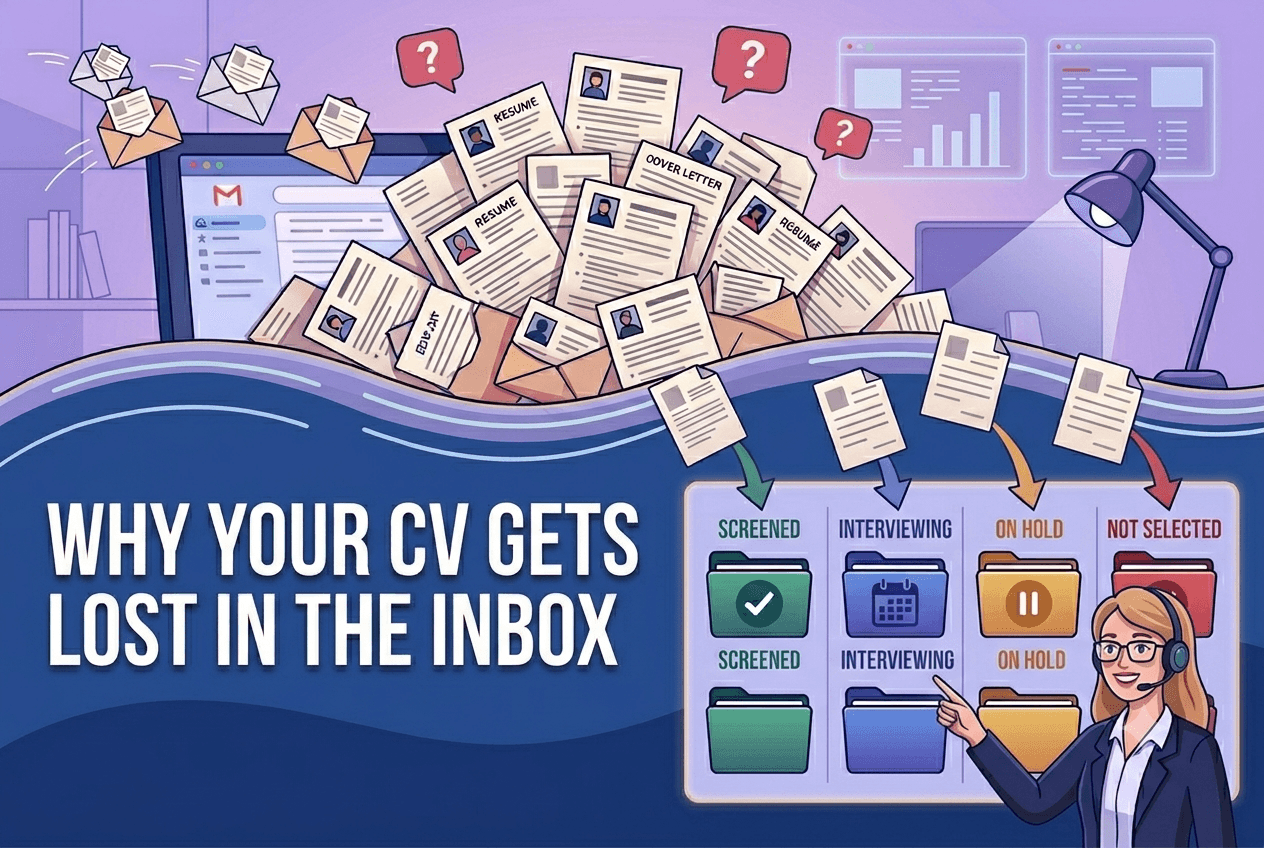
You submitted your CV two weeks ago. You thought it was perfect. You even customized the cover letter, followed the company’s exact instructions, applied through their official portal. Then silence.
No acknowledgment. No interview invitation. No rejection. Just… nothing.
The frustrating truth? Your CV might actually be excellent. It’s probably not you. It’s how companies organize applications.
In 2026, 53% of job seekers were ghosted by employers, according to Criteria Corp’s 2026 Candidate Experience Report. Even worse: 61% of candidates never receive a status update or formal rejection after applying. But here’s the part that might surprise you: most of this isn’t malice, it’s chaos.
And this article explains exactly why it happens, what it costs, and how professional recruiters are fixing it.
- Posting more jobs
- Expanding sourcing channels
- Increasing spending on ads or agencies
But these solutions only address the surface. The real issue isn’t a lack of talent. It’s how hiring systems are designed. Every time a new role opens, the process starts from scratch. No continuity. No reusable data. No existing pipeline. That’s why hiring remains slow no matter how many applicants you receive.
The Problem: How CVs Actually Get Lost
A. The Email Spreadsheet Nightmare
Many companies, especially SMBs, still rely on what we call ‘the email spreadsheet approach. A spreadsheet in Google Sheets or Excel tracking candidates, with actual CVs scattered across Gmail folders, forwarded inboxes, and shared drives.
Here’s what happens: Your CV arrives in the main recruitment inbox. It gets forwarded to the hiring manager. They forward it to the team lead. Three people are now in the email chain. Your CV lives in three different inboxes. When the hiring manager goes on vacation, nobody can find your application because it’s in their inbox, not a central database.
Result: Your application has not been rejected. It is just not assigned to any stage yet.
B. The Multiple Inboxes Problem
CVs don’t just come from email anymore. In 2026, candidates apply through: email, LinkedIn, the company’s career page, referral forms, and other external platforms. That means your application could be sitting in five different systems simultaneously, and nobody cross-checks them.
A candidate might be a perfect fit for a role, but if they applied via LinkedIn and the recruiter is only checking their email inbox, you’ll never meet.
C. The Manual Organization Breakdown
According to research from 2026, recruiters spend roughly 2-3 hours per day just organizing, searching for, and manually categorizing CVs. That’s 40% of their workday spent on busy work instead of actually evaluating candidates.
And when something goes wrong, someone leaves the company, takes a vacation, or gets promoted to CVs to get orphaned. A 2026 Bullhorn Staffing Report found that 55% of recruiters using organized ATS systems save 10+ hours per week on candidate screening. That’s not a small difference. That’s the difference between chaos and order.
D. The Silent Consequence: Your CV Is ‘Somewhere’
At a glance, here’s what’s happening from a candidate’s perspective:
- You submitted your CV. You think it’s being reviewed.
- Actually, it’s in someone’s Gmail inbox, unsorted.
- That person is busy, forgets about it, or doesn’t know it came in.
- You get ghosted. Not because you’re unqualified, but because the company is unorganized.
The Impact: What This Costs Everyone
For Job Seekers: Time, Confidence, and Burnout
You may start thinking: ‘Maybe my CV isn’t good enough. Maybe I need a different format. Maybe I should change my entire resume. But you don’t know that the real issue is a recruiter’s disorganized inbox. The psychological toll is real: self-doubt, frustration, and eventually, burnout.
For Recruiters & HR Teams: Lost Time and Lost Talent
The real cost hits recruitment teams even harder. Companies without a centralized system are losing qualified candidates while chasing weaker ones.
And the recruitment timeline? An effective ATS can decrease the average hiring cycle by as much as 60%. That means you hire faster, reduce cost-per-hire, and get your new employee productive sooner.
How Professional Recruiters Actually Organize Applications
A. Centralized Candidate Database
Instead of: ‘Let me search my Gmail for John’s CV’ or ‘Where did we save that resume file?’
Professional teams: John’s profile is in our candidate database with his CV, email, phone, application date, and interview notes in one place.
That’s the difference. One system. All CVs. No more lost applications.
B. Clear Pipeline Stages
Professional recruiters organize candidates by stage:
- Application Received
- Screening Complete
- Interview Scheduled
- Offer Extended
- Hired or Rejected
When a candidate moves between stages, everyone knows. It’s transparent. No more wondering ‘Where are we in this process?’
C. Automated Organization (Resume Parsing)
Here’s where it gets powerful: modern ATS platforms automatically read your CV and extract information (your email, phone number, other key information). No manual data entry.
D. Team Visibility/ Collaboration
When CVs are organized in a central system, the entire recruitment team can see them. If one recruiter goes on vacation, a backup recruiter can pick up the candidates. If someone leaves the company, your CV doesn’t leave with them.
This is why 62% of teams using an ATS find more high-quality candidates compared to those using traditional, fragmented systems.
E. Automatic Email Updates to Candidates
Keeping candidates informed doesn’t have to be a manual task. With automated email templates, recruiters can send timely updates throughout the hiring process with just a few clicks:
- Thanks for applying! We received your CV.
- Your interview is scheduled for Tuesday at 2 PM. Google Meet/ Teams link
- We’ve decided to move forward with another candidate. Here’s our feedback.
You get closure. No guessing. No ghosting. That’s professional.
The Results
Companies using modern ATS platforms report:
- 60% faster hiring cycles
- 62% higher quality candidates identified
- 55% of recruiters save 10+ hours per week on screening
- Dramatically reduced candidate ghosting and better employer brand reputation
For Job Seekers: What to Look For
When you apply to a company, you can often tell if they’re using a modern ATS:
- You get an instant automated confirmation email (not an hour later, instantly).
- You can check application status online anytime.
- You receivetimelyupdates (even if it’s a rejection—at least you know).
- Interview details come with calendar invites and clear instructions, not fragmented emails.
If you’re applying to a company that only says ’email us your CV’ with no confirmation system, expect longer wait times and more ghosting. It’s not your fault—it’s their process.
For Recruiters & HR Teams: Time to Modernize
If your team is still using spreadsheets and scattered Gmail inboxes, you’re losing talented candidates and wasting 40% of your time on administrative busywork.
A modern ATS isn’t a luxury—it’s essential. And the investment pays for itself through faster hiring, better candidates, and a stronger employer brand.
Ready to build a smarter hiring process?
Visit Enfue to see how our ATS keeps candidates engaged, your team aligned, and your pipeline transparent. Or book a personalized demo to see exactly how it works for your team.


 News: enfue strives to become the #1 Applicant Tracking System in Vietnam: Explained video →